The End of Paper Credentials: How MeritSeal Is Re-Engineering Professional Trust
By Tech & Workforce Correspondent
Introduction: The Crisis of Unverified Credentials
In an increasingly decentralized and fast-moving global job market, validating professional competency has become a major challenge for hiring teams, regulatory bodies, and educational institutions. Traditional PDF certificates and paper documents—once the gold standard of qualification—are increasingly vulnerable to fabrication, alteration, and outright fraud. Employers and recruiters routinely face the administrative friction of manual outreach and days-long verification backlogs.
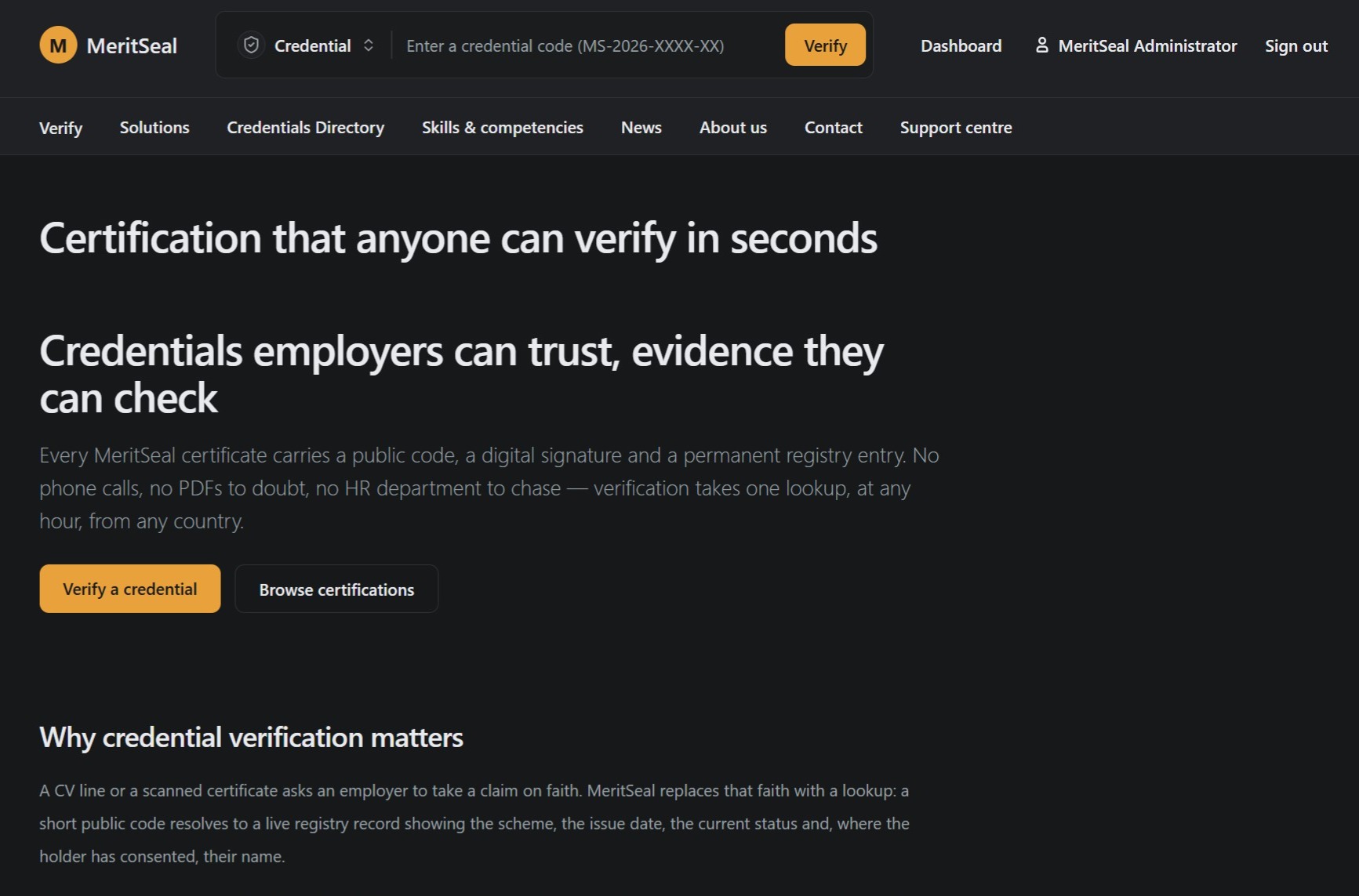
To address these vulnerabilities, the MeritSeal credentialing platform has established a decentralized, cryptographically secure registry that turns professional qualifications into instant, verifiable public infrastructure[cite: 1]. Rather than relying on easily manipulated static documents, the system provides real-time certainty for candidates and verifiers alike.
Under the Hood: Cryptographic Signatures and Public Infrastructure
At the core of the platform’s architecture is a zero-trust model powered by cryptographic standards. When a certificate is awarded, it is authenticated using a secure private key and linked directly to public verification keys via an open JWKS (JSON Web Key Set) endpoint. If any entity attempts to alter the document—whether changing a candidate’s name, score, or expiration date—the cryptographic signature is immediately invalidated.
To ensure that these credentials remain accessible across regions and time zones, verification data is hosted on an independent, stateless verification registry with high availability. Through automated verification APIs, platforms, background checkers, and human resource management systems can streamline authentication pipelines without relying on slow manual interventions.
Human Governance Meets Algorithmic Rigor
While automation powers the distribution and validation layers, the platform places heavy emphasis on human governance when it comes to quality standards and assessment design. Qualifications are structured against well-defined skills and competency standards, utilizing psychometric evaluations, subject-matter expert panels, and rigorous cut scores.
Crucially, the architecture prevents automated systems from making irreversible administrative decisions. Critical actions such as appeals, policy exceptions, and credential revocations require explicit human review paired with permanent record-keeping. When a credential must be withdrawn, the update is logged immediately on the public revocation list to prevent unauthorized usage.
End-to-End Workflows for Modern Stakeholders
The platform offers purpose-built workflows designed to support candidates, issuers, and verifying organizations across the entire credential lifecycle:
- For Working Professionals: Candidates can select recognized assessment schemes, complete proctored or unproctored evaluations, and receive a permanent unique code. This identifier integrates seamlessly into resumes, portfolios, and online profiles, allowing candidates to prove their qualifications with absolute transparency.
- For Issuers and Organizations: Enterprise clients, academic institutions, and training providers can leverage comprehensive credentialing solutions. The system supports custom scheme design, bulk credential issuance, cohort reporting, audit compliance trails, and structured fee models.
- For Verifiers and Employers: Recruiters, background checking agencies, and regulators can simply visit the public portal to authenticate credentials. By entering a credential’s public identifier, third parties can immediately confirm issuance dates, scheme details, recipient names (subject to consent), and active status free of charge.
Conclusion: The Future of Portable Professional Identity
As global hiring continues to expand and remote-first workplaces become standard, the demand for portable, tamper-evident identity verification will only grow[cite: 1]. By bridging the gap between rigorous assessment standards and cryptographic verification, modern credential infrastructure ensures that qualifications remain authentic, transparent, and universally verifiable[cite: 1].